How to Build a Stunning “Neo-Deco” Geometric Breakfast Board
For years, the culinary world has been dominated by the “cottagecore” aesthetic. We have seen countless rustic, overflowing charcuterie boards where the charm lies in the chaotic, abundant, and slightly messy presentation. Meats are casually draped, berries are scattered with reckless abandon, and cheeses are crumbled into organic piles. But a new trend is taking over the world of high-end hosting and social media styling: the “Neo-Deco” Geometric Breakfast Board.
This striking, highly organized approach to food styling draws heavy inspiration from the Art Deco movement of the 1920s and 30s, fused with modern minimalist sensibilities. It is about architectural precision, bold symmetry, sharp lines, and intentional negative space. If you are looking for breathtaking aesthetic brunch ideas that will leave your guests speechless, learning how to craft a geometric breakfast platter is the ultimate culinary party trick.
The Philosophy Behind Neo-Deco Food Styling
To truly master art deco food styling, you have to change the way you look at ingredients. You are no longer just serving food; you are building a temporary edible sculpture. The Neo-Deco philosophy relies on a few core design principles:
1. Symmetry and Repetition: Art Deco design heavily features repeating geometric patterns. On your board, this translates to slicing ingredients into identical shapes and fanning them out in flawless, overlapping lines or perfect grids.
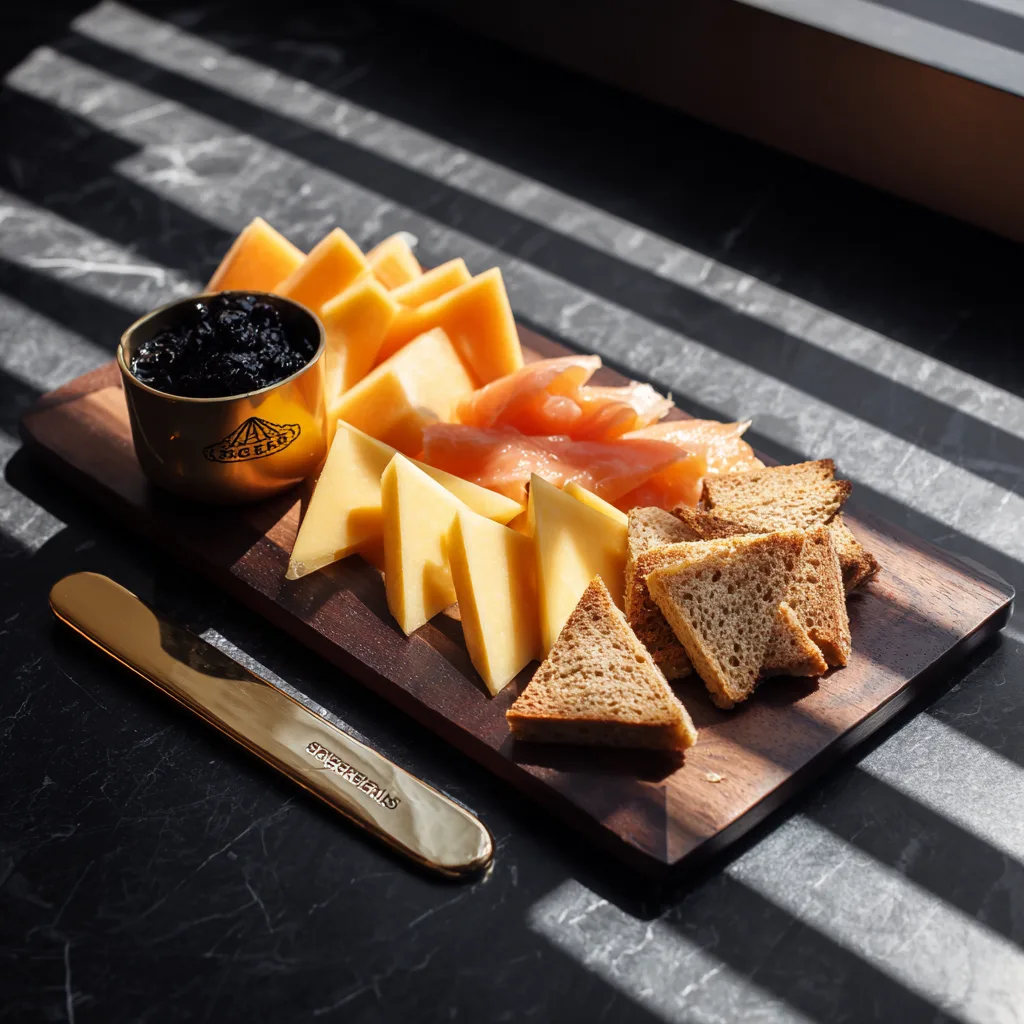
2. High Contrast: Visual impact is key. You want stark contrasts between colors and textures. Think bright orange, perfectly cubed cheddar cheese sitting next to a stark, dark row of blackberries. The board itself should offer contrast—which is why dark slate, black marble, or very dark woods work best as your canvas.
3. Negative Space: Unlike rustic boards that cover every square inch of the wood, a modern geometric charcuterie board uses empty space intentionally. Leaving a sleek border of the dark board visible around your perfectly arranged ingredients frames the food like a piece of modern art.
4. Precision: There is no room for tearing or tearing bread or crumbling cheese. Every cut must be deliberate, using sharp knives and geometric cutters to enforce structure.
The Essential Tools for Architectural Plating
You cannot build a structurally sound, perfectly aligned neo-deco breakfast board with dull knives and your bare hands. To achieve this level of aesthetic perfection, you need a few specialized tools in your kitchen arsenal:
- A Very Sharp Chef’s Knife: This is non-negotiable. A dull knife will crush your bread, tear your meats, and leave ragged edges on your cheese. A freshly honed, sharp blade guarantees clean, razor-sharp lines.
- A Food-Safe Ruler: Yes, really. Professional food stylists use rulers to ensure every cube of cheese or slice of toast is the exact same dimension. It might seem extreme, but it is the secret to a flawless grid layout.
- Geometric Cookie Cutters: Small stainless steel cutters in the shape of perfect circles, squares, and hexagons are incredible for standardizing the shape of softer fruits (like melon) or cutting uniform pieces of cured meats.
- A Mandoline Slicer: For achieving paper-thin, perfectly even slices of apples, cucumbers, or radishes that can be fanned out like a deck of cards.
- Culinary Tweezers: For placing tiny garnishes, like individual blueberries or edible flowers, precisely where you want them without messing up the surrounding layout.
Selecting the Right Ingredients for Structure
Not all breakfast foods are suited for geometric styling. Runny eggs, messy jams (unless contained in geometric ramekins), and crumbly pastries will destroy the clean lines of your board. You must select ingredients that hold their shape.
Ingredients That Work Best
The Foundation (Carbohydrates)
- – 4 thick slices of dense brioche or milk bread (crusts removed, cut into exact squares or precise triangles)
- – 1 box of square or hexagonal crackers (for structural stacking)
- – 2 medium-sized, perfectly square Belgian waffles (cut into perfect quarters)
The Architecture (Proteins & Dairy)
- – 8 oz firm block of sharp cheddar or gouda cheese (cut into 1-inch perfect cubes)
- – 6 oz sliced Provolone or Swiss cheese (cut into sharp triangles)
- – 4 oz smoked salmon (sliced into long, uniform ribbons for tight rolling)
- – 4 oz salami or cured meat (cut with a circular cutter to ensure identical sizing, or folded into sharp, architectural cones)
- – 2 hard-boiled eggs (sliced laterally into perfect disks)
The Color Blocks (Fruits & Vegetables)
- – 1/2 cantaloupe or honeydew melon (cut into 1-inch perfect cubes to match the cheese)
- – 1 large, firm green apple (sliced paper-thin on a mandoline)
- – 1 pint of fresh blackberries (sorted for identical size)
- – 1 kiwi (peeled and cut into uniform hexagonal or square slices)
The Accents (Dips & Garnishes)
- – 1/2 cup thick Greek yogurt or cream cheese (served in a square or sharply angled ramekin)
- – 1/4 cup dark berry jam (served in a matching geometric ramekin)
- – Fresh rosemary sprigs (trimmed to look like sharp little pine trees, not scattered wildly)
Step-by-Step Instructions: Assembling the Masterpiece
Building a modern breakfast platter is an exercise in patience. Put on some jazz, pour yourself a cup of coffee, and treat this like an art project.
- Prepare the Canvas: Start with a completely clean, large rectangular or square board. Dark slate, black marble, or a very dark, un-grained wood are ideal. Place the board on your serving table before you begin assembling—once it is built, moving it might disturb your precise alignments.
- Place the Anchors: Your anchors are the ramekins holding the yogurt and jam. Place these down first. Instead of centering them, place them off-center or in opposite corners to create visual tension. Ensure they are aligned with the edges of the board.
- Build the Grids: Take your cubed cheese and cubed melon. Create a checkerboard pattern or two separate, tightly packed square blocks of color. Use your ruler or the flat edge of your knife to gently push the cubes together so the outer edges form perfectly straight lines.
- Create the Fans: Take your square or triangular bread points and fan them out in a straight line or a sharp, 90-degree angle. Do the same with the mandoline-sliced apples. The overlap of each slice should be exactly the same.
- Structure the Meats: Avoid the classic, messy “salami river.” Instead, fold round slices of meat exactly in half, then in half again to form sharp triangles. Stand them up on their edges in a tightly packed, straight line. For the smoked salmon, roll the ribbons tightly into uniform, modern-looking cylinders and stand them upright.
- Fill with Intentional Blocks: Use your uniform crackers, sliced hard-boiled eggs, and blackberries to fill the remaining spaces. Instead of mixing them, keep them heavily color-blocked. A stark, straight row of black berries next to a bright white row of egg slices creates a stunning visual pop.
- The Final Polish: Take a step back and look at the board from above. Are the lines straight? Are the angles sharp? Use your culinary tweezers to adjust any wayward pieces. Finally, place your rosemary sprigs strategically—perhaps standing straight up like architectural columns, or laid perfectly parallel to a row of crackers.
“Neo-Deco” Geometric Breakfast Board
Ingredients
Equipment
Method
- Place your dark serving board on the final display table. Position the geometric ramekins (filled with yogurt and jam) off-center to create visual anchors.
- Using a ruler and a sharp knife, cut your cheese and melon into precise 1-inch cubes. Arrange them on the board in tightly packed, perfectly straight grids or checkerboard patterns.
- Cut the toast and waffles into exact squares or sharp triangles. Fan them out in a straight line or a sharp 90-degree angle, ensuring equal overlapping.
- Fold the round salami slices twice to form sharp triangles. Stand them up on their edges in a tightly packed, straight row.
- Roll the smoked salmon ribbons into uniform cylinders and arrange them vertically in a neat cluster.
- Fill the remaining negative space with strict, straight lines of uniform blackberries, crackers, and sliced eggs. Do not mix the elements; keep them heavily color-blocked.
- Use culinary tweezers to perfect all straight lines and angles. Place rosemary sprigs strictly parallel or perpendicular to the food rows. Serve immediately.
Notes
Advanced Techniques for Geometric Styling
Once you are comfortable with the basic grids and fans, you can elevate your aesthetic brunch ideas with some advanced knife work.
The Chevron Cut: Instead of slicing fruit normally, use a paring knife to cut sharp, zig-zag lines around the equator of a kiwi or melon, pulling the halves apart to reveal a striking, spiky, star-like geometric pattern. This provides a stunning, complex shape to break up the squares and lines.
The Interlocking Grid: Cut two contrasting colors of cheese (like white cheddar and orange cheddar) into perfectly equal rectangular batons. Stack them like a Jenga tower or interlock them to create a woven, checkerboard wall of cheese on your board.
The Negative Space River: Instead of filling the board entirely, leave a sharp, diagonal line of empty black slate running straight through the middle of the board. Arrange your food on either side of this “river.” This bold use of negative space is incredibly modern and sophisticated.
Serving Suggestions & Pairings
A board this elegant requires beverages and tableware that match the vibe. Ditch the mismatched coffee mugs and rustic wooden spoons.
Serve your Neo-Deco board alongside a sleek, stainless steel French press or a minimalist pour-over coffee carafe. If you are serving alcohol, mimosas or bellinis should be poured into sharp, angular crystal coupes or tall, straight-edged champagne flutes—avoid rounded wine glasses.
Provide your guests with small, geometric plates (square or hexagonal plates are stunning) and modern, matte black or brushed gold flatware. The entire table setting should feel cohesive, sharp, and luxurious.
Why the Neo-Deco Trend is Taking Over
The rise of the neo-deco breakfast board is a direct response to visual fatigue. We have seen so many overflowing, messy grazing tables that they no longer feel special or curated. The geometric board is a return to craftsmanship.
It shows your guests that you have put thought, time, and precise effort into their meal. It is not just about throwing expensive ingredients onto a piece of wood; it is about treating food as a medium for design. Furthermore, in the age of Instagram and Pinterest, the bold lines, high contrast, and satisfying symmetry of a geometric board photograph exceptionally well.
Final Thoughts
Creating a “Neo-Deco” Geometric Breakfast Board requires a shift in mindset. It demands patience, a steady hand, and an eye for spatial design. But the result is undeniable. By utilizing symmetry, sharp lines, and intentional color blocking, you can transform everyday breakfast staples like cheese, bread, and fruit into a jaw-dropping culinary centerpiece.
The next time you are hosting a brunch, leave the rustic vibes behind. Grab your ruler, sharpen your knife, and embrace the elegant, architectural beauty of the Neo-Deco movement. Your guests—and their cameras—will thank you.