Stunning Mango Curd Tart: A Tropical Dessert Masterpiece
There are certain desserts that capture the absolute essence of a season or a feeling, and this Stunning Mango Curd Tart is the culinary embodiment of a tropical paradise. Imagine a dessert that perfectly balances the rich, buttery crumble of a classic French shortbread crust with the intensely vibrant, sweet, and slightly tangy punch of pure mango. It is sunshine on a plate, elegantly dressed up with edible flowers and fresh fruit, making it a show-stopping centerpiece for spring brunches, summer dinner parties, or any occasion that calls for a truly memorable sweet treat.
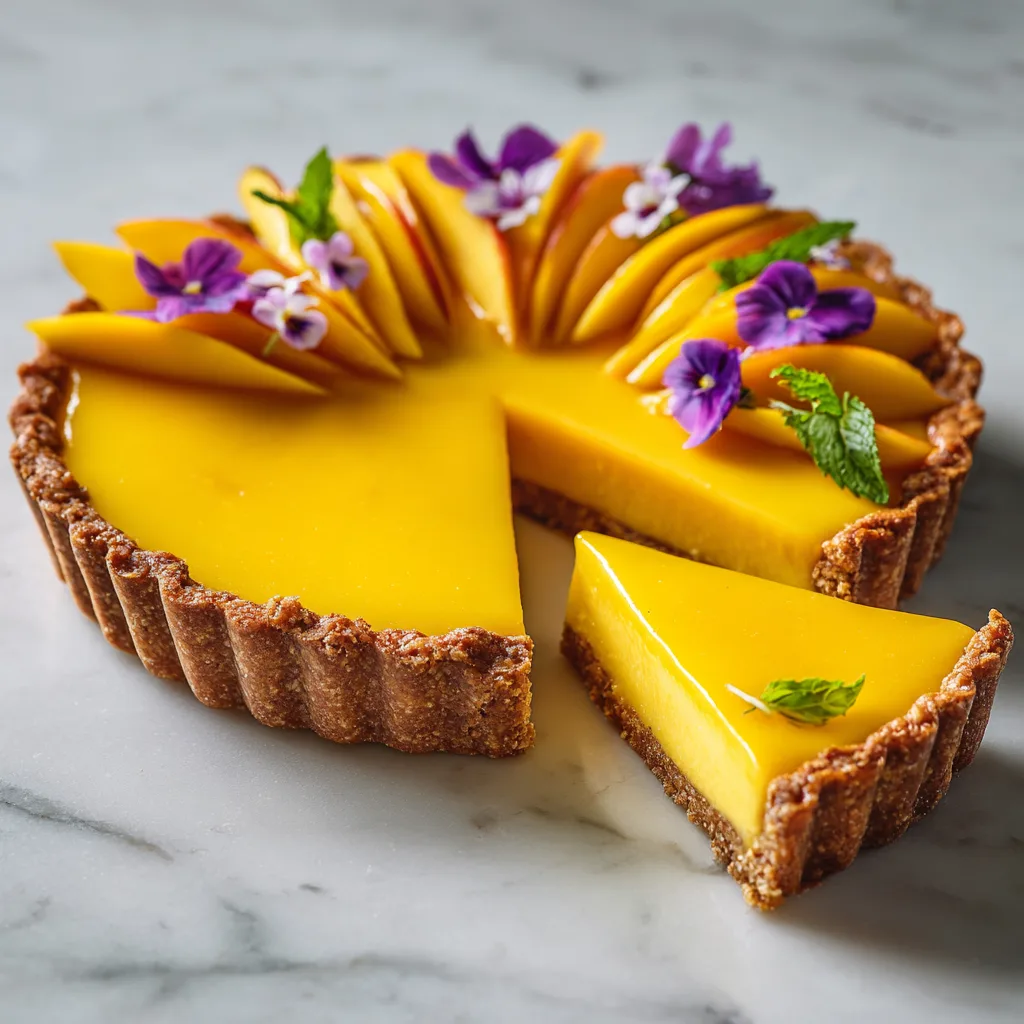
While chocolate and vanilla often dominate the dessert table, fruit curds offer a bright, palate-cleansing alternative that feels simultaneously rich and refreshing. Lemon curd is the classic standard, but swapping the citrus out for the “king of fruits”—the glorious mango—creates a flavor profile that is sweeter, more aromatic, and undeniably exotic. The curd is silky smooth, melting on the tongue, while the tart shell provides the necessary structural snap and buttery richness to ground the tropical notes. Beyond its incredible taste, this tart is a visual marvel. The brilliant, natural golden-yellow hue of the mango filling contrasts breathtakingly with the vibrant purple of edible flowers, making it look like a dessert plucked straight from a high-end patisserie window.
The Magic of Mangoes: Choosing the Right Fruit
The success of this tart hinges entirely on the quality of the mangoes you choose. Not all mangoes are created equal, especially when it comes to making a smooth, flavorful curd. You need mangoes that are incredibly sweet, highly aromatic, and, most importantly, possess a smooth, non-fibrous flesh. Stringy mangoes will result in a lumpy curd that is difficult to strain and unpleasant to eat.
Ataulfo Mangoes (Honey Mangoes): These are undeniably the best choice for making mango curd. They are small, kidney-shaped, and turn a deep golden yellow when fully ripe. Their flesh is buttery smooth with absolutely no fibrous strings, making them a dream to puree. They also boast an intensely sweet, floral flavor that shines beautifully in the finished tart.
Alphonso Mangoes: Often considered the premium mango globally, Alphonsos have a rich, creamy texture and a spectacular flavor profile. If you can find fresh Alphonso mangoes, or even high-quality canned Alphonso mango puree (often found in South Asian markets), your tart will be unparalleled. If using canned puree, ensure it is unsweetened, or adjust the sugar in the recipe accordingly.
What to Avoid: Try to avoid large, green-and-red Tommy Atkins mangoes if possible. While they are the most common variety in Western supermarkets, their flesh tends to be quite fibrous and stringy, and their flavor is often milder and more watery than their golden counterparts. If you must use them, you will need to be meticulous about pureeing and passing the mixture through a fine-mesh sieve multiple times.
Anatomy of the Perfect Tart: The Crust and the Curd
A phenomenal tart is an exercise in contrast. You need the crisp, sturdy shell to contrast with the soft, luscious filling. Understanding the two components of this recipe will ensure your success in the kitchen.
The Pâte Sablée (Shortbread Crust)
For a wet filling like a curd, you need a crust that is “short”—meaning it is rich in fat and low in gluten development. We use a classic Pâte Sablée, a French shortcrust pastry that bakes up crisp, tender, and cookie-like. The high butter content acts as a barrier, preventing the wet mango curd from instantly turning the crust soggy. Blind baking (pre-baking the crust before adding the filling) is absolutely mandatory here. If you pour raw curd into a raw crust, you will end up with a disappointing, doughy bottom.
The Silky Mango Curd
A curd is fundamentally a fruit custard. It relies on the coagulation of egg proteins and the emulsification of butter to achieve its thick, spreadable, velvety texture. Because mangoes are naturally sweeter and far less acidic than lemons, making mango curd requires a slight formulation tweak compared to a classic lemon curd. We must add fresh lemon juice to the mango puree. This isn’t just for flavor (though the acidity brightens the mango beautifully); it is scientifically necessary. The acid helps the egg proteins set properly and lowers the pH, which prevents the eggs from scrambling too quickly when exposed to heat.
Essential Ingredients for Your Mango Tart
Gathering high-quality ingredients is the first step toward pastry perfection. Here is exactly what you will need:
- For the Tart Crust:
- All-Purpose Flour: Provides the structure. Do not use bread flour, as the higher protein will make the crust tough.
- Powdered Sugar (Confectioners’ Sugar): Dissolves beautifully into the dough, creating a finer, more tender crumb than granulated sugar.
- Unsalted Butter: Must be very cold and cut into cubes. Cold butter creates little pockets of steam as it bakes, contributing to the crust’s flakiness.
- Egg Yolk: Adds richness, color, and binds the dough together without adding too much water.
- Ice Water: Just a splash, only if needed, to bring the dough together.
- Vanilla Extract & Salt: For depth of flavor.
- For the Mango Curd:
- Fresh Mango Puree: The star of the show. You will need about 2 to 3 large, ripe, smooth-fleshed mangoes, blended until completely smooth.
- Fresh Lemon Juice: Crucial for balancing the sweetness and aiding in the setting of the eggs. Do not use bottled lemon juice.
- Granulated Sugar: Sweetens the curd and helps inhibit the eggs from coagulating too quickly.
- Whole Eggs and Egg Yolks: The whole eggs provide structure and volume, while the extra yolks provide unmatched richness and a deeper golden color.
- Unsalted Butter: Cut into pieces and softened slightly. This is whisked in at the very end (off the heat) to emulsify into the curd, giving it a glossy sheen and a velvety mouthfeel.
- For the Garnish:
- Fresh Mango Slices: Thinly sliced for a beautiful fan effect around the border.
- Edible Flowers: Violas, pansies, or miniature food-safe orchids provide a stunning pop of contrasting purple.
- Fresh Mint Leaves: For a touch of green and a fresh aroma.
Step-by-Step Instructions: Crafting the Tart
Take your time with these steps. Pastry requires patience, but the results are incredibly rewarding.
- Prepare the Crust Dough: In a food processor, pulse together the flour, powdered sugar, and a pinch of salt. Add the cold, cubed butter and pulse in brief bursts until the mixture resembles coarse sand with some pea-sized butter pieces remaining. Add the egg yolk and vanilla extract. Pulse again until the dough just begins to clump together. If it is too dry, add ice water one teaspoon at a time.
- Chill the Dough: Turn the dough out onto a piece of plastic wrap, form it into a smooth disk, wrap it tightly, and refrigerate for at least 1 hour. This rests the gluten and chills the butter, preventing shrinkage during baking.
- Roll and Form the Shell: On a lightly floured surface, roll the chilled dough out to a 12-inch circle. Carefully transfer the dough to a 9-inch fluted tart pan with a removable bottom. Gently press the dough into the bottom and up the sides of the pan. Trim the excess dough flush with the top edge. Prick the bottom all over with a fork (docking). Freeze the unbaked shell for 30 minutes.
- Blind Bake the Crust: Preheat your oven to 375°F (190°C). Line the frozen tart shell with a piece of crumpled parchment paper and fill it to the brim with pie weights, dried beans, or uncooked rice. Bake for 15-20 minutes until the edges are pale golden. Carefully remove the parchment and weights, and bake for another 10-15 minutes until the bottom is dry and golden brown. Let cool completely on a wire rack.
- Prepare the Mango Puree: Peel and pit the mangoes. Place the flesh in a blender or food processor and blend until completely liquid. Pass this puree through a fine-mesh sieve to remove any rogue fibers. Measure out 1 cup of smooth puree.
- Cook the Curd: In a medium heat-proof bowl or the top of a double boiler, whisk together the mango puree, lemon juice, whole eggs, egg yolks, and granulated sugar until well combined. Place the bowl over a pot of gently simmering water (ensure the bottom of the bowl does not touch the water). Cook, whisking constantly and gently, until the mixture thickens significantly. It should coat the back of a spoon and leave a clear trail when you swipe your finger through it (this should take about 10-15 minutes). The temperature should reach about 170°F (77°C) on an instant-read thermometer.
- Emulsify the Butter: Immediately remove the bowl from the heat. Pour the hot curd through a clean fine-mesh sieve into a clean bowl to catch any tiny bits of cooked egg. While the curd is still hot, add the cubed, room-temperature butter a few pieces at a time, whisking gently until completely melted and emulsified before adding more.
- Fill and Chill: Pour the warm, silky mango curd into the cooled, pre-baked tart shell. Smooth the top with an offset spatula. Let it sit at room temperature for 30 minutes, then carefully transfer to the refrigerator. Chill for at least 4 hours, or preferably overnight, until the curd is completely set and firm.
- Garnish and Serve: Just before serving, carefully remove the tart from the fluted pan. Arrange thin slices of fresh mango around the perimeter of the tart. Carefully place edible purple flowers and tiny sprigs of mint among the mango slices. Slice with a sharp, warm knife and serve immediately.
Stunning Mango Curd Tart
Ingredients
Equipment
Method
- Make the crust: Pulse flour, powdered sugar, and salt in a food processor. Add cold cubed butter and pulse until coarse crumbs form. Add egg yolk and vanilla; pulse until dough comes together. Add ice water if too dry.
- Form dough into a disk, wrap in plastic, and chill for at least 1 hour.
- Roll out chilled dough and press into a 9-inch tart pan. Prick the bottom with a fork. Freeze for 30 minutes.
- Blind bake the crust: Line with parchment, fill with pie weights, and bake at 375°F (190°C) for 15-20 minutes. Remove weights and bake another 10-15 minutes until golden. Let cool.
- Make the curd: Whisk mango puree, lemon juice, granulated sugar, whole eggs, and egg yolks in a heatproof bowl set over a pot of gently simmering water.
- Cook, whisking constantly, until the mixture thickens and reaches 170°F (77°C), about 10-15 minutes.
- Remove from heat and immediately strain through a fine-mesh sieve. Whisk in the softened butter pieces until smooth and emulsified.
- Pour the warm curd into the cooled tart shell. Let sit at room temperature for 30 minutes, then refrigerate for at least 4 hours until set.
- Before serving, garnish the edges with fresh mango slices, edible flowers, and mint leaves. Slice with a warm, clean knife.
Notes
Pro Tips for Tart Perfection
To ensure your dessert looks and tastes like it came from a professional kitchen, keep these expert tips in mind:
- Do Not Skip the Sieve: Straining the mango puree before cooking, and straining the finished curd after cooking, are non-negotiable steps. This is the secret to a professional, silky-smooth mouthfeel. Even a tiny piece of scrambled egg or mango fiber will ruin the luxurious texture.
- Gentle Heat is Key: When cooking the curd, patience is your best friend. If the water beneath your double boiler is boiling vigorously, the eggs will scramble before the curd has a chance to thicken properly. Keep the water at a gentle simmer.
- Prevent a Soggy Bottom: If you are worried your crust isn’t baked enough to hold the wet filling, you can employ a baker’s trick: brush the bottom of the hot, fully baked crust with a very thin layer of beaten egg white or melted white chocolate, and let it set before pouring in the curd. This creates an impermeable seal.
- Cutting the Perfect Slice: Curd tarts can be messy to slice. For clean, sharp cuts, fill a tall container with hot water. Dip a long, sharp chef’s knife into the hot water, wipe it completely dry with a towel, and make a cut. Repeat the dip-and-wipe process for every single slice.
Troubleshooting Common Curd Issues
Making fruit curds can be intimidating, but understanding the chemistry helps you fix or avoid common pitfalls.
Why is my curd runny? If your curd hasn’t set after hours in the fridge, it wasn’t cooked long enough. The eggs need to reach about 170°F to coagulate and thicken the mixture. Additionally, if you reduced the butter in the recipe, the curd will be looser, as the butter helps firm it up as it chills. Unfortunately, a deeply undercooked curd cannot usually be re-cooked successfully once it has been chilled. You can, however, use a runny curd as a delicious sauce over pancakes or ice cream!
Why does my curd taste metallic? Always use non-reactive cookware when making curds. The acid in the lemon juice and fruit can react with unlined aluminum, copper, or cast iron bowls and whisks, imparting a harsh, metallic flavor and sometimes turning the curd a muddy color. Stick to glass, stainless steel, or silicone.
Why did my tart crust shrink in the oven? Crust shrinkage is usually caused by two things: overworking the gluten or failing to rest the dough. If you knead the dough too much, the gluten becomes elastic and snaps back in the heat. Resting the dough in the fridge (and the freezer right before baking) relaxes the gluten and keeps the butter cold, ensuring the crust holds its shape.
Delicious Variations and Serving Suggestions
This basic recipe is a wonderful canvas for tropical flavor exploration. If you want to put a twist on the classic Mango Curd Tart, try these ideas:
Passionfruit Mango Tart
Passionfruit and mango are a match made in heaven. Substitute 1/4 cup of the mango puree with fresh, strained passionfruit juice. The passionfruit adds an intense, fragrant tartness that balances the sweet mango brilliantly. You can even drizzle a little passionfruit pulp with the seeds over the top for garnish.
Coconut Mango Tart
Lean into the island vibes by incorporating coconut. You can substitute a quarter of the flour in the crust with finely desiccated coconut. For serving, top the tart with a generous dollop of coconut whipped cream (made from chilled full-fat coconut milk) and toasted coconut flakes.
Serving Recommendations
While this tart is incredibly flavorful on its own, a small accompaniment can elevate the plate. A quenelle of unsweetened vanilla bean whipped cream cuts the richness perfectly. If serving on a hot summer evening, a scoop of delicate coconut sorbet or a refreshing scoop of lemon basil ice cream on the side creates an unforgettable dessert course. Pair with an iced green tea or a light, effervescent Moscato d’Asti.
Storage and Make-Ahead Instructions
Because this dessert requires chilling time, it is the ultimate make-ahead recipe for entertaining.
Make-Ahead: You can make the tart crust dough up to 3 days in advance and keep it tightly wrapped in the fridge, or freeze it for up to a month. You can also blind bake the shell a day in advance; just store it at room temperature covered lightly with a towel. The mango curd can be made, strained, and kept in an airtight container in the fridge for up to a week before you fill the tart.
Storing Leftovers: Once assembled, the Mango Curd Tart should be kept in the refrigerator. Store it in an airtight container or carefully cover it with an inverted bowl (so plastic wrap doesn’t ruin the pristine surface). It is best enjoyed within 2 to 3 days, after which the crust will slowly begin to absorb moisture and lose its snap.
Freezing: We do not recommend freezing the fully assembled tart. The freezing and thawing process alters the cellular structure of the curd, often causing it to weep liquid and ruining the texture of both the filling and the crust. Enjoy it fresh!
Bringing this stunning Mango Curd Tart to the table is guaranteed to elicit gasps of admiration. With its buttery, crisp shell, its velvety, sweet-tart filling, and its breathtaking floral presentation, it is a masterclass in elegant, tropical dessert-making. Gather your freshest mangoes, take your time with the curd, and prepare to serve a slice of pure sunshine.